Algebraic Manipulation
23 Problems • 3 sub-topics
Adalynn Le • 5/2/2026
Table of Contents
Introduction
Algebraic Manipulation is how you actually solve expressions, equations, and any sort of problem. It can be anything from solving a one-step system to using complex creativity and ideas to simplify huge expressions. Algebraic manipulation is all about using creativity and a set array of tools and knowledge to apply them to different situations.
Basic Operations + Systems Equations
Basic Operations
Most likely, you've solved a single step equation before, but in the spirit of review, we'll cover it anyways. The goal of algebraic manipulation is to isolate a variable to find what it is equivalent to. In order to do this, we perform opposite operations to both sides of an equation . Note that the operations must be opposite because the goal is to eliminate coefficients, constants, etc. by doing something that turns them into one (for coefficients) or zeroes (for constants), which is the opposite operation. We must apply them on both sides in order to keep the two expressions equivalent. By nature, adding constants to two expressions or multiplying them by a constant should not affect the value, because you should always be able to simplify it by subtracting or dividng by that value.
Another thing to note is that we should always use a "backwards PEMDAS", where we do addition and subtraction first, then multiplication and division, then exponents and parentheseis. With that in mind, complete the following excercise
Which operation should you do FIRST to isolate x? Assume you are trying to keep it on the same side
Systems of Equations
Systems of equations and algebraic manipulation are really the foundation of any algebra problem. The first is the setup, the second is the execution. Pretty much everything we are using algebraic manipulation on will either be a single equation, system of equations, or expressions. I would the say systems are more common simply because the AMC provides an inherent complexity that can only be managed with multiple equations. Systems of Equations can be solved in 3 main ways
Graphing
Use desmos (or on the AMC 10) just sketch each equation and see the common meeting place (best for when there are only 2 variables)
Subtraction
Add or subtract equations to eliminate variables. Really quick but only works in some cases.
Substitution
Isolate one variable and substitute into others. Best with linear equations
Factoring
Factoring is the biggest trick for making complicated questions easy because you can turn polynomials into a bunch of linear expressions. We'll start by going over what factoring is in general, and then dive into some of the more niche tricks and topics.
Factoring is just taking out the Greatest Common Factor, whether that be a constant or an expression. The Greatest Common Factor isthe greatest value that two or more things can be divided by evenly. Chances are that if you have at least a middle-school education, you've done some basic factoring before in the distributive property. For example, how would you factor the following equation?
\(25x+40\)
You would ideally recognize a common factor of \(5\) and factor that out for \(5(5x+8)\). Factoring polynomials is no different except instead of using constants, expressions
Equations vs Expressions
Just a quick knowledge check, make sure you know the difference between equations and expressions. Equations have equal signs, expressions do not. You can only factor out expressions
Factoring By Grouping
Factoring by grouping is the process of grouping terms in an expression (typically first two last two, but it could be scrambled) and factoring out the GCF. If the GCF is not immediately visible factor out whatever you can, like finding the prime factorization of a constant, and see what matches.. Factoring by grouping is great for when the system is clear and organized. While it may not be the best when terms are combined, it works great for four-part expressions. Furthermore, it is fairly simple and intuitive to get a grasp on factoring before we move on to difference of squares and FOIL. In mathematical terms, it looks like this: \(ax+ay+bx+by=(ax+ay)+(bx+by)=a(x+y)+b(x+y)=(a+b)(x+y)\)
Practice
\(3x^3+x^2+9x+3\)
Quadratic Trinomials
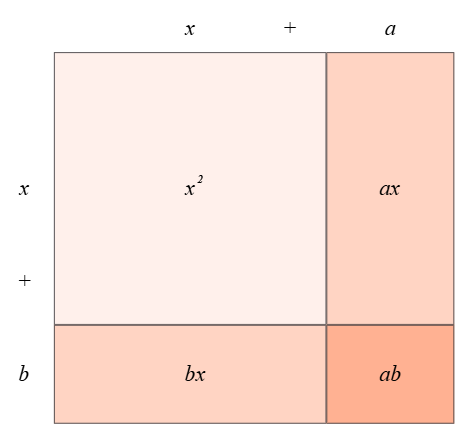
Chances are that factoring trinomials is the first thing you will learn when getting into advanced algebra. Trinomials are expressions with three terms of different exponential value. Quadratic trinomials have a \(x^2\), \(x\), and constant. If you've seen a quadratic equation, it's the standard form \(ax^2+bx+c\). When factoring, we switch to the form \((dx+e)(fx+g)\) with the following rules
- \(d \times f = a\)
- \(e \times g = c\)
- \(d \times f + e \times g\)
If you've heard of FOIL (a method for organized expansion going front-outside-inside-last where you multiply terms in linear expression distributive property), this is essentially the opposite, or reversing the FOIL, because if you notice you can FOIL the factored form and combine like terms to get the original equation
Factoring Identities
Now that you know how to factor, you already have the tools for algebraic manipulation, but you need to be proficient in them and use them well. Rather than spending time trying to remember how to factor, find GCFs, and factor out expressions, you can learn to recognize these identities to save you time on the test
Difference of Squares
The difference of squares is a factoring pattern that occurs whenever you have an equation \(x^2-c\) where \(c\) is a perfect square. The equation simplifies down to \((x+\sqrt{c})(x-\sqrt{c})\), which you can solve via FOIL. Albeit this particular trick is well known, it's applications are limitless. Consider the name: "Difference of Squares", it's not talking about quadratics, this is true for whenever you have two squares that are being subtracted. You can use this to simplify and solve large expressions in addition to manipulating expressions with variables. There also exists differences of larger powers. For example, the difference of cubes is \(x^3-b^3=(x-b)(x^2+xb+b^2)\)
Simon's Favorite Factoring Trick
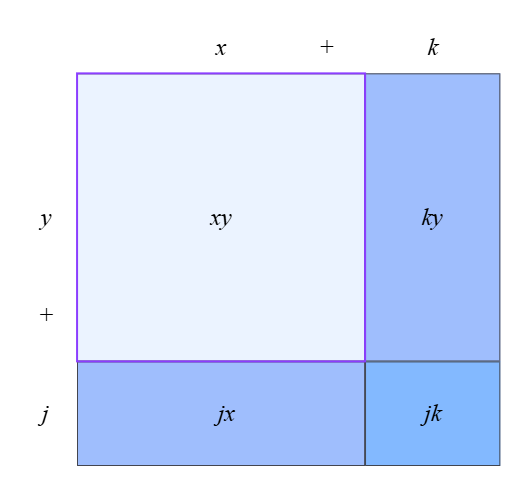
Simon's Favorite Factoring Trick (SFFT) is one of the most popular factoring tricks because of it's nature and exclusivity. It is primarily used for diophantine equations where \(xy\) is a term (the values are multiplied). The trick allows you to express the sys isolate \(x\) and \(y\) as variables instead of having them as products or fractions. As an expression, you would have \(xy+jx+ky-jk=(x+k)(y+j)\). I find it is easier to express as an equation, though: if \(xy+jx+ky=a\) then\((x+k)(y+j)=a-jk\). The proof for it is pretty straightforward as well.
\(xy+jx+ky=a\)
\(x(y+j)+ky=a\)
\(x(y+j)+ky+jk=a+jk\)
\(x(y+j)+k(y+j)=a+jk\)
\((x+k)(y+j)=a+jk\)
Sophie Germain Identity
The Sophie German identity is a tool used to compute and factor higher-power expressions. It's formula is \(a^4+4b^2=(a^2+2ab+2b^2)(a^2-2ab+2b^2)\). If you notice, this looks a lot like a difference of squares, because that's what it is. What makes the Sophie Germain identity unique is that it's a blend of the difference of squares and completing the square. If you add \(4a^2b^2 (2ab^2)\), and also subtract it (to keep it equal) you can rewrite as \((a^2+2b^2)^2-(2ab)^2\) which when expanded using the difference of squares gives \((a^2+2ab+2b^2)(a^2-2ab+2b^2)\)
Sum of Three Cubes Identity
This is a pretty niche and high-level identity, so don't worry too much about it. It will likely only appear in 20+ questions or AIME:
\(a^3+b^3+c^3-3abc=(a+b+c)(a^2+b^2+c^2-ab-ac-bc)\)
Other Factoring Tools
Completing the Square
Completing the square is the method of adding or subtracting whatever you need on both sides of an equation so that you can turn it into a perfect square. For example in quadratic equations, that means adding a value such that \(c=\frac{b}{2}^2\)
Visualizing \(x^2 + bx + ?\)
Substitution
See a question super complex? Find the GCF, or a common trend and pattern, and substitute it for a variable. Variables don't have to just represent constants, they also represent expressions. This can allow you to visualy simplify an expression and make it easier to manipulate through factoring. Especially for complex expressions, this could mean that even though there is only one value or expression for \(u\) (which is the placeholder variable we tend to substitute), there can be multiple values for \(x\)
Click to substitute
\(2x^2+6x\)\(+ 4 (\)\(2x^2+6x\)\()+3\)Conclusion
Algebraic Manipulation is a crucial skill for turning a problem into a solution. By using skills like factoring and substitution, you can simplify complex expressions until they are able to be solved rationally. Algebraic Manipulation is the fondation for many other skills in Algebra and for solving any sort of equation.
Question 1:
Loading question...
Welcome Back!
Access your progress across all your devices