Factoring
10 Problems • 5 sub-topics
Adalynn Le • 5/15/2026
Table of Contents
Introduction
Factoring is a trick in algebraic manipulation that allows you to divide an expression into more simple, often monomial or binomial ones, that act as factors to the original. The basis of factoring is simply the idea of the distributive property, a trick almost everybody does. Advanced factoring parodies this with expressions instead of constants
Factoring By Grouping
Factoring by grouping is the process of grouping terms in an expression (typically first two last two, but it could be scrambled) and factoring out the GCF. If the GCF is not immediately visible factor out whatever you can, like finding the prime factorization of a constant, and see what matches.. Factoring by grouping is great for when the system is clear and organized. While it may not be the best when terms are combined, it works great for four-part expressions. Furthermore, it is fairly simple and intuitive to get a grasp on factoring before we move on to difference of squares and FOIL. In mathematical terms, it looks like this: \(ax+ay+bx+by=(ax+ay)+(bx+by)=a(x+y)+b(x+y)=(a+b)(x+y)\)
Factoring by grouping is a good introductory way to learn factoring, but it may not always work. Compared to factoring quadratic trinomials the conditions are very specific. Factoring by grouping only works when you have an even number of terms that all share a common factor. Factoring by grouping does have one direct use though: it is easily applied in equations with two variables, for example \(x^2\) and \(y^2\) because you can group them separately. In these situations, factoring by grouping will allow you to understand how the variables affect and influence each other.
Practice
\(3x^3+x^2+9x+3\)
Quadratic Trinomials
Chances are that factoring trinomials is the first thing you will learn when getting into advanced algebra. Trinomials are expressions with three terms of different exponential value. Quadratic trinomials have a \(x^2\), \(x\), and constant. If you've seen a quadratic equation, it's the standard form \(ax^2+bx+c\). When factoring, we switch to the form \((dx+e)(fx+g)\) with the following rules
- \(d \times f = a\)
- \(e \times g = c\)
- \(d \times f + e \times g\)
If you've heard of FOIL (a method for organized expansion going front-outside-inside-last where you multiply terms in linear expression distributive property), this is essentially the opposite, or reversing the FOIL, because if you notice you can FOIL the factored form and combine like terms to get the original equation
Completing the Square
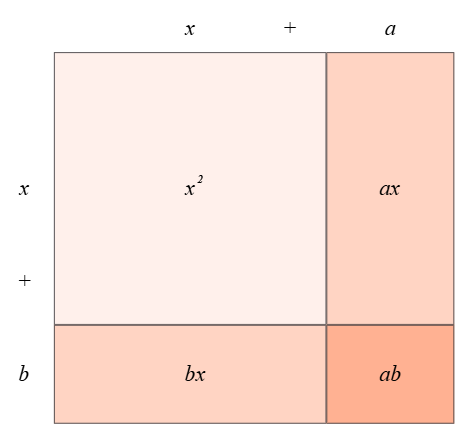
Completing the square is the method of adding or subtracting whatever you need on both sides of an equation so that you can turn it into a perfect square. For example in quadratic equations, that means adding a value such that \(c=\frac{b}{2}^2\)
Visualizing \(x^2 + bx + ?\)
Substitution
See a question super complex? Find the GCF, or a common trend and pattern, and substitute it for a variable. Variables don't have to just represent constants, they also represent expressions. This can allow you to visualy simplify an expression and make it easier to manipulate through factoring. Especially for complex expressions, this could mean that even though there is only one value or expression for \(u\) (which is the placeholder variable we tend to substitute), there can be multiple values for \(x\)
Click to substitute
\(2x^2+6x\)\(+ 4 (\)\(2x^2+6x\)\()+3\)Factoring Identities
Now that you know how to factor, you already have the tools for algebraic manipulation, but you need to be proficient in them and use them well. Rather than spending time trying to remember how to factor, find GCFs, and factor out expressions, you can learn to recognize these identities to save you time on the test
Difference of Squares
The difference of squares is a factoring pattern that occurs whenever you have an equation \(x^2-c\) where \(c\) is a perfect square. The equation simplifies down to \((x+\sqrt{c})(x-\sqrt{c})\), which you can solve via FOIL. Albeit this particular trick is well known, it's applications are limitless. Consider the name: "Difference of Squares", it's not talking about quadratics, this is true for whenever you have two squares that are being subtracted. You can use this to simplify and solve large expressions in addition to manipulating expressions with variables. There also exists differences of larger powers. For example, the difference of cubes is \(x^3-b^3=(x-b)(x^2+xb+b^2)\)
Simon's Favorite Factoring Trick
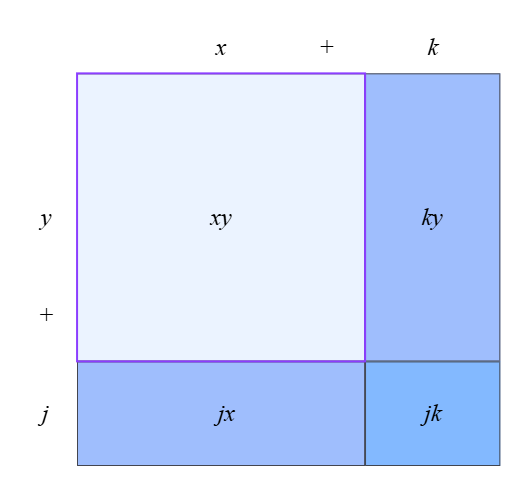
Simon's Favorite Factoring Trick (SFFT) is one of the most popular factoring tricks because of it's nature and exclusivity. It is primarily used for diophantine equations where \(xy\) is a term (the values are multiplied). The trick allows you to express the sys isolate \(x\) and \(y\) as variables instead of having them as products or fractions. As an expression, you would have \(xy+jx+ky-jk=(x+k)(y+j)\). I find it is easier to express as an equation, though: if \(xy+jx+ky=a\) then\((x+k)(y+j)=a-jk\). The proof for it is pretty straightforward as well.
\(xy+jx+ky=a\)
\(x(y+j)+ky=a\)
\(x(y+j)+ky+jk=a+jk\)
\(x(y+j)+k(y+j)=a+jk\)
\((x+k)(y+j)=a+jk\)
Sophie Germain Identity
The Sophie German identity is a tool used to compute and factor higher-power expressions. It's formula is \(a^4+4b^2=(a^2+2ab+2b^2)(a^2-2ab+2b^2)\). If you notice, this looks a lot like a difference of squares, because that's what it is. What makes the Sophie Germain identity unique is that it's a blend of the difference of squares and completing the square. If you add \(4a^2b^2 (2ab^2)\), and also subtract it (to keep it equal) you can rewrite as \((a^2+2b^2)^2-(2ab)^2\) which when expanded using the difference of squares gives \((a^2+2ab+2b^2)(a^2-2ab+2b^2)\)
Sum of Three Cubes Identity
This is a pretty niche and high-level identity, so don't worry too much about it. It will likely only appear in 20+ questions or AIME:
\(a^3+b^3+c^3-3abc=(a+b+c)(a^2+b^2+c^2-ab-ac-bc)\)
Conclusion
Factoring is an important trick that help syou simplify hard problems and reduce them into basic parts. It is heavily reliant on a knowledge of multiplication and division and treats whole expressions as factors that contribute to a larger operation, just as a constant would have smaller constant factors. Factoring is useful for finding zeroes and solutions to equations. Using identities, you can factor easily without having to prove or derive on your own.
Question 1:
Loading question...
Welcome Back!
Access your progress across all your devices
Need Some Help?
Contact us through our form