Trigonometry
7 Problems • 2 sub-topics
Isaac Cho • 7/14/2026
Introduction
Trigonometry is the study of angles and their relations in triangles. It is really popular on the MC 10 and a fundamental branch of geometry.
Basics
Trigonometry is the fundamental branch of maths that deals with triangles, including the relationships between their side lengths and angles.
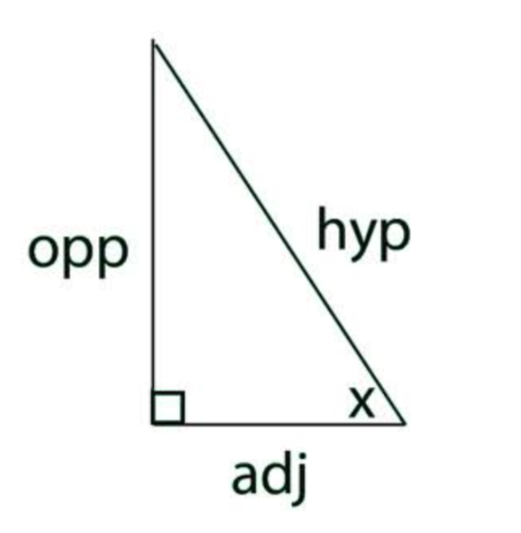
First, let’s observe a right angled triangle.
Here, we are trying to find the angle \(x\). Given this, we can denote the sides of the triangle with special terminology.
- The longest side of the triangle is called the hypotenuse.
- The side directly opposite to the angle x is called the opposite.
- The side directly next to angle x (the remaining side) is called the adjacent.
Now, we will introduce trigonometric ratios. These will help allow us to calculate angle \(x\).
\(\sin(x)=\frac{\textup{opposite}}{\textup{hypotenuse}}\) \(\cos(x)=\frac{\textup{adjacent}}{\textup{hypotenuse}}\) \(\tan(x)=\frac{\textup{opposite}}{\textup{adjacent}}\)
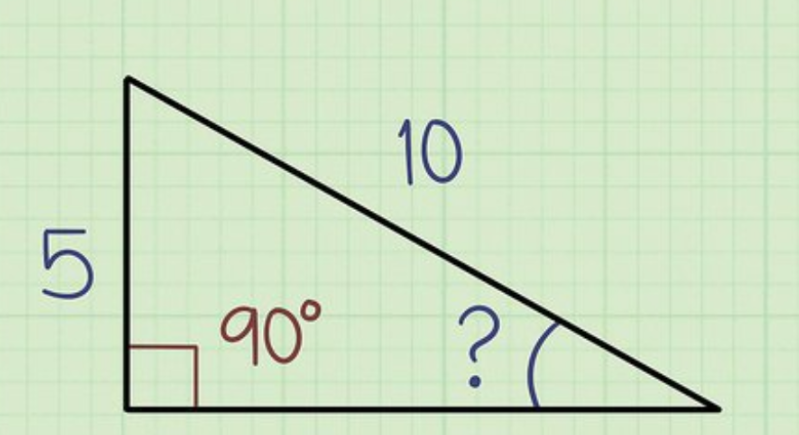
Here, we are trying to find the angle of the triangle denoted by the ? question mark. We are given 2 values of the triangle. The 5 represents the opposite of the triangle, as this side is directly opposite to the angle we are trying to find. The 10 is the triangle’s hypotenuse.
As we know the opposite and hypotenuse values, we can use the sine function to calculate the missing angle.
Thus \(\sin(?)=\frac{5}{10}\)
When we are trying to find the angle of a right angled triangle given 2 side lengths, we use the arcsine function. The arcsine function is the inverse of the sine function, which will allow us to find the missing angle.
\(\textup{arcsin}(\frac{5}{10})=? \textup{or} \sin^{-1}(?)=\frac{5}{10}\)
Note here that \(\sin^{-1}=\textup{arcsin}\), not \(\frac{1}{\textup{sin}}\)
Plugging into a calculator gives \(x=30^\circ\)
Rules and Identities
Identities on the Unit Circle
| Degrees (º) | Radians (rad) | \(\sin(\theta)\) | \(\cos(\theta)\) | \(\tan(\theta)\) | Coordinate \((x, y)\) |
|---|---|---|---|---|---|
| Quadrant I | |||||
| \(30^\circ\) | \(\frac{\pi}{6}\) | \(\frac{1}{2}\) | \(\frac{\sqrt{3}}{2}\) | \(\frac{\sqrt{3}}{3}\) | \(\left(\frac{\sqrt{3}}{2}, \frac{1}{2}\right)\) |
| \(45^\circ\) | \(\frac{\pi}{4}\) | \(\frac{\sqrt{2}}{2}\) | \(\frac{\sqrt{2}}{2}\) | \(1\) | \(\left(\frac{\sqrt{2}}{2}, \frac{\sqrt{2}}{2}\right)\) |
| \(60^\circ\) | \(\frac{\pi}{3}\) | \(\frac{\sqrt{3}}{2}\) | \(\frac{1}{2}\) | \(\sqrt{3}\) | \(\left(\frac{1}{2}, \frac{\sqrt{3}}{2}\right)\) |
| Quadrant II | |||||
| \(120^\circ\) | \(\frac{2\pi}{3}\) | \(\frac{\sqrt{3}}{2}\) | \(-\frac{1}{2}\) | \(-\sqrt{3}\) | \(\left(-\frac{1}{2}, \frac{\sqrt{3}}{2}\right)\) |
| \(135^\circ\) | \(\frac{3\pi}{4}\) | \(\frac{\sqrt{2}}{2}\) | \(-\frac{\sqrt{2}}{2}\) | \(-1\) | \(\left(-\frac{\sqrt{2}}{2}, \frac{\sqrt{2}}{2}\right)\) |
| \(150^\circ\) | \(\frac{5\pi}{6}\) | \(\frac{1}{2}\) | \(-\frac{\sqrt{3}}{2}\) | \(-\frac{\sqrt{3}}{3}\) | \(\left(-\frac{\sqrt{3}}{2}, \frac{1}{2}\right)\) |
| Quadrant III | |||||
| \(210^\circ\) | \(\frac{7\pi}{6}\) | \(-\frac{1}{2}\) | \(-\frac{\sqrt{3}}{2}\) | \(\frac{\sqrt{3}}{3}\) | \(\left(-\frac{\sqrt{3}}{2}, -\frac{1}{2}\right)\) |
| \(225^\circ\) | \(\frac{5\pi}{4}\) | \(-\frac{\sqrt{2}}{2}\) | \(-\frac{\sqrt{2}}{2}\) | \(1\) | \(\left(-\frac{\sqrt{2}}{2}, -\frac{\sqrt{2}}{2}\right)\) |
| \(240^\circ\) | \(\frac{4\pi}{3}\) | \(-\frac{\sqrt{3}}{2}\) | \(-\frac{1}{2}\) | \(\sqrt{3}\) | \(\left(-\frac{1}{2}, -\frac{\sqrt{3}}{2}\right)\) |
| Quadrant IV | |||||
| \(300^\circ\) | \(\frac{5\pi}{3}\) | \(-\frac{\sqrt{3}}{2}\) | \(\frac{1}{2}\) | \(-\sqrt{3}\) | \(\left(\frac{1}{2}, -\frac{\sqrt{3}}{2}\right)\) |
| \(315^\circ\) | \(\frac{7\pi}{4}\) | \(-\frac{\sqrt{2}}{2}\) | \(\frac{\sqrt{2}}{2}\) | \(-1\) | \(\left(\frac{\sqrt{2}}{2}, -\frac{\sqrt{2}}{2}\right)\) |
| \(330^\circ\) | \(\frac{11\pi}{6}\) | \(-\frac{1}{2}\) | \(\frac{\sqrt{3}}{2}\) | \(-\frac{\sqrt{3}}{3}\) | \(\left(\frac{\sqrt{3}}{2}, -\frac{1}{2}\right)\) |
Laws and Identities
| Reciprocal & Quotient Identities | |
| Reciprocal | \[\csc(\theta) = \frac{1}{\sin(\theta)}, \quad \sec(\theta) = \frac{1}{\cos(\theta)}, \quad \cot(\theta) = \frac{1}{\tan(\theta)}\] |
|---|---|
| Quotient | \[\tan(\theta) = \frac{\sin(\theta)}{\cos(\theta)}, \quad \cot(\theta) = \frac{\cos(\theta)}{\sin(\theta)}\] |
| Pythagorean Identities | |
| Sine & Cosine | \[\sin^2(\theta) + \cos^2(\theta) = 1\] |
| Tangent & Secant | \[1 + \tan^2(\theta) = \sec^2(\theta)\] |
| Cotangent & Cosecant | \[1 + \cot^2(\theta) = \csc^2(\theta)\] |
| Sum and Difference Formulas | |
| Sine | \[\sin(\alpha \pm \beta) = \sin(\alpha)\cos(\beta) \pm \cos(\alpha)\sin(\beta)\] |
| Cosine | \[\cos(\alpha \pm \beta) = \cos(\alpha)\cos(\beta) \mp \sin(\alpha)\sin(\beta)\] |
| Tangent | \[\tan(\alpha \pm \beta) = \frac{\tan(\alpha) \pm \tan(\beta)}{1 \mp \tan(\alpha)\tan(\beta)}\] |
| Double & Half-Angle Formulas | |
| Double Angle | \[\sin(2\theta) = 2\sin(\theta)\cos(\theta)\] \[\cos(2\theta) = \cos^2(\theta) - \sin^2(\theta) = 2\cos^2(\theta) - 1 = 1 - 2\sin^2(\theta)\] \[\tan(2\theta) = \frac{2\tan(\theta)}{1 - \tan^2(\theta)}\] |
| Half Angle | \[\sin\left(\frac{\theta}{2}\right) = \pm\sqrt{\frac{1 - \cos(\theta)}{2}}\] \[\cos\left(\frac{\theta}{2}\right) = \pm\sqrt{\frac{1 + \cos(\theta)}{2}}\] \[\tan\left(\frac{\theta}{2}\right) = \pm\sqrt{\frac{1 - \cos(\theta)}{1 + \cos(\theta)}} = \frac{1 - \cos(\theta)}{\sin(\theta)} = \frac{\sin(\theta)}{1 + \cos(\theta)}\] |
| Laws of Non-Right Triangles | |
| Law of Sines | \[\frac{a}{\sin(A)} = \frac{b}{\sin(B)} = \frac{c}{\sin(C)}\] |
| Law of Cosines | \[a^2 = b^2 + c^2 - 2bc\cos(A)\] \[b^2 = a^2 + c^2 - 2ac\cos(B)\] \[c^2 = a^2 + b^2 - 2ab\cos(C)\] |
| Triangle Area | \[\text{Area} = \frac{1}{2}ab\sin(C) = \frac{1}{2}bc\sin(A) = \frac{1}{2}ac\sin(B)\] |
Conclusion
Trigonometry is an essential tool for studying the relationships of shapes and triangles in the unit circle. It has many formulas to memorize, but these can be derived easily through basic knowledge.
Question 1:
Loading question...
Welcome Back!
Access your progress across all your devices
Need Some Help?
Contact us through our form